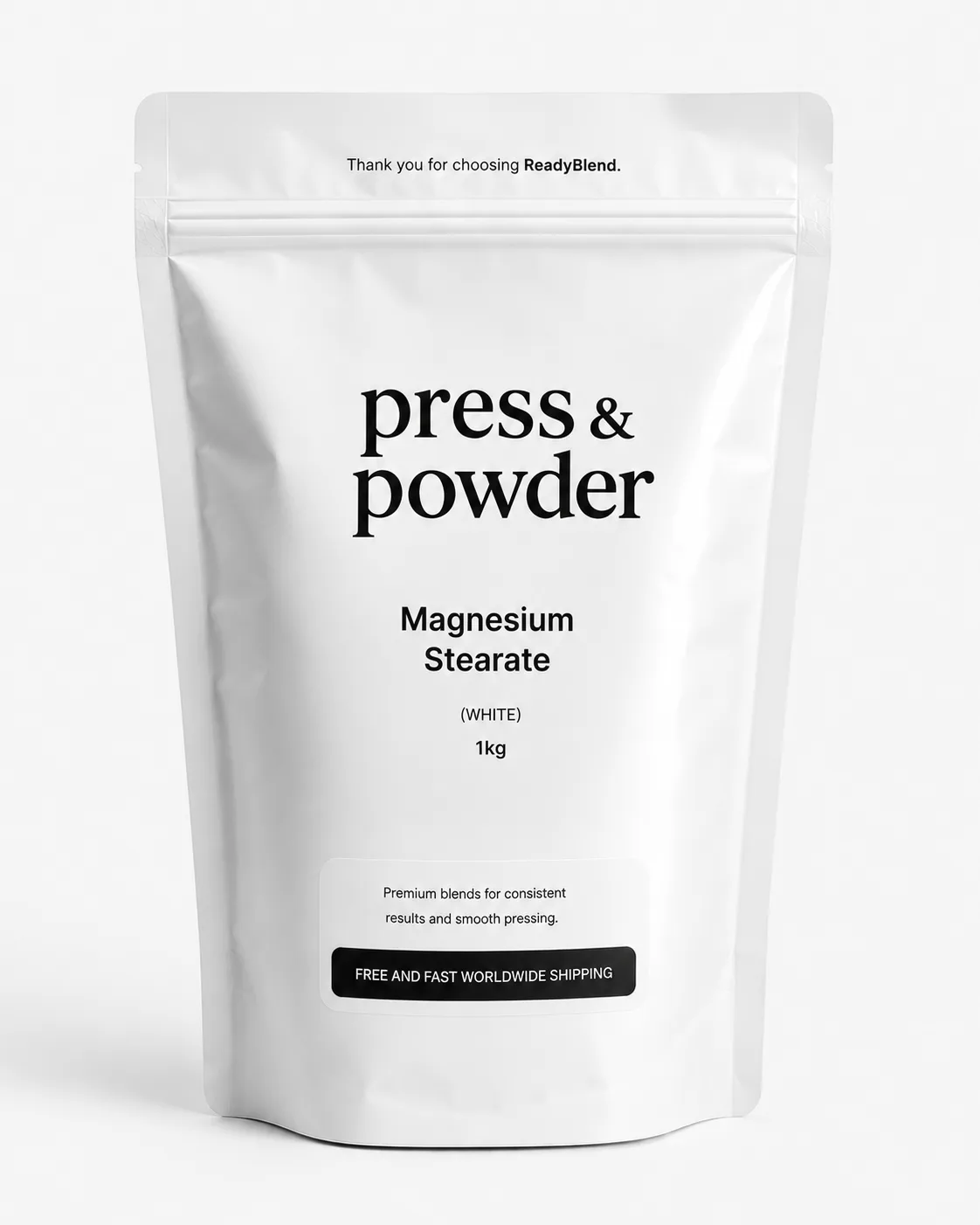
The standard tablet lubricant. Add at 0.5–2% for the final minutes of blending only — reduces friction between the tablet and die wall so it ejects cleanly instead of sticking or tearing.
Ships in 1–2 days · View cart & checkout
The near-universal choice for direct compression — reliably reduces die-wall friction so tablets eject without sticking or tearing.
A small amount goes a long way. 0.5–2% of the total blend is typical — more than that doesn't help ejection further and starts to work against the tablet.
Added at the end of blending and mixed for only a minute or two. Overmixing coats the other particles and is one of the most common causes of soft, weak tablets.
Confirm performance for your specific formulation with your own testing before a production run.
| Spec | Value |
|---|---|
| Appearance | White, fine powder |
| Role | Lubricant |
| Physical state | Solid |
| Directly compressible | Not on its own — used as a minor additive |
| Typical use rate | 0.5–2% of the total blend, added last |
| Approx. mesh size | >200 mesh (fine) |
| Storage | Room temperature, sealed container |
| Bag sizes | 1 kg, 2 kg, 5 kg |
| Bulk sizes | 25 kg, 500 kg pallet lots |
0.5–2% of the total blend is typical. Start at the low end and increase only if tablets are sticking in the die or tearing on ejection.
Overmixing a lubricant coats the other particles and can weaken bonding between them under compression. Mix it in briefly, only at the end — see diagnosing capping and lamination for what over-lubrication looks like.
It reduces friction between the compressed tablet and the die wall, so the tablet ejects cleanly instead of sticking, tearing, or capping.
4.7 out of 5, based on 3 reviews.
Clean ejection at 1% — no sticking on our punches even after long runs.
A small amount goes a long way. No issues with tablet hardness at our usual ratio.
Works as expected. Just watch for overmixing — it can soften tablets if you go too long.